


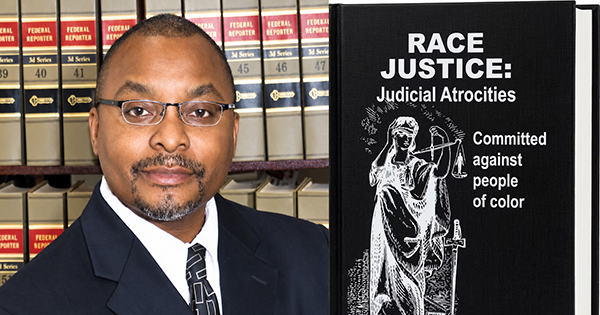
Nationwide — Rogers Hicks, for the past few decades, has engaged in a mission to eradicate white supremacy in our judicial system. In his book, Race Justice: Judicial Atrocities Committed Against People of Color, he presents a compilation of documents, including official court records and case-history comparisons dating back at least 50 years, documenting disparities in punishment between Black and White defendants, and the techniques used by judges, prosecutors, and police to abuse their authority, suborn perjury, and otherwise deprive minorities of their constitutional rights under the guise of judicial process. Importantly, the book also offers a remedy in the form of judicial reform, paralleling reform efforts now underway in many states throughout the United States. This educational guide, packed with knowledge, is a must-read for all.
Hicks’ Efforts to Eradicate Racial Discrimination by the Elimination of All-White Jury Oversight on Afro-American Cases
Among Hicks’ efforts was a petition, launched on Change.org on August 19, 2013, for repeal of the Supreme Court’s decision in Batson v. Kentucky, 476 U.S. 79, a decision that reaffirmed that Afro-Americans have no right to a jury which include members of their own race, upholding old Jim Crow-era precedent that sanctioned Black litigants (civil and/or criminal cases) to be tried by all-white juries. The Change.org petition closed with 682 supporters. Hicks sought to repeal the Batson v. Kentucky ruling, a practice shown for decades to have devastating and destructive effects on the lives of people of color by depriving that group of a fair and impartial jury system under the guise of judicial process. He comments, “I challenge each and every individual, Black or White, to just imagine themself facing a trial and being confronted with a jury lacking any member of their own race?”
Malcolm X used the phrase “chickens coming home to roost” in December 1963 to describe the assassination of President John F. Kennedy as the inevitable blowback of a violent “climate of hate” fostered by American foreign and domestic policies. That phrase was later illustrated when White citizens were confronted with the painful reality of facing a Black jury (a jury selected on behalf of O.J. Simpson, a Black man, accused of killing Nicole Simpson and Ron Goldman, both Caucasians). The importance and significance of a jury composed of at least some members of one’s own race were painfully acknowledged. The Black jury acquitted O.J., and what followed was massive protest and outcry from White people who believed the acquittal was based on race — racial bias in favor of one person’s race as opposed to the victims — rather than the evidence of guilt before them.
The O.J. Simpson murder trial commenced on January 24, 1995, approximately seven months after the murders. The jury was predominantly composed of African American members: of the 12 jurors, 9 were Black, 1 was Hispanic, and 2 were White. Polling conducted in subsequent years indicated that over half of Black respondents believed Simpson was guilty, despite the jury’s decision to acquit him. The defense preferred a jury of mostly Black jurors, while the prosecution aimed for White jurors.
The jury’s composition became a focal point, raising questions about the influence of race in the trial’s outcome. The predominance of Black jurors, which included 8 women and 1 man, was significant given the racial context of the case. Reports suggested that the perception of racial bias might have influenced the jurors’ perspectives on guilt and innocence. Consequently, the jury composition ultimately reflected broader societal tensions. The final verdict delivered by the jury encapsulated the complexities surrounding race, justice, and public perception in America.
Prosecutor Christopher Darden stated publicly that he knew — not merely believed — that Simpson was guilty of two horrific murders. But he was equally certain from the beginning that the mostly Black jury would acquit Simpson, because it was payback for a century of racial injustice. In his book, In Contempt, Darden wrote: “I felt an injustice had been done, and that someone should say something about that.” He continued, “No matter how much I wanted the jurors to look beyond race,” he writes, “I don’t think they could.”
Call to Action
Hicks’ recent work includes a New York CPL 440.10 motion asking the Erie County court to vacate the criminal conviction of Benjamin Castricone after twelve years of imprisonment, decades of claimed innocence, unmatched fingerprint evidence, conviction by an all-white jury, corroborating sworn confessions, and troubling parallels to other recently Buffalo, N.Y. wrongful-conviction cases. The motion asserts actual innocence. The most troubling part of the motion is that officials had obtained information that the wrong man had been convicted, but did not investigate and turned a blind eye to evidence establishing Castricone’s actual innocence.
His book can be purchased online at RaceJustice-JACAPOC.com
For more information:
Press Release – https://castricone-casedocs.com/pressrelease.html
YouTube Video – https://www.youtube.com/watch?v=X4fj02P1PBM
Email: justice4castricone@castricone-casedocs.com
Case materials may be viewed at the website: castricone-casedocs.com
For press inquiries, contact racejustice@yahoo.com