


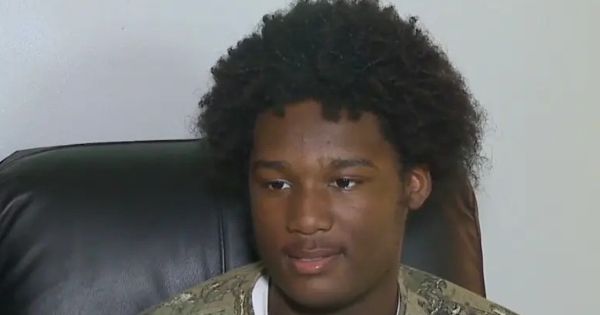
Nationwide — Taki Allen, a 16-year-old African American student from Baltimore County, Maryland, is one of four Black teenagers suing an AI security company, their school district, and local police after a school surveillance system mistook a bag of chips for a gun. The false alert brought armed officers to their school and led to the teens being handcuffed and searched despite posing no threat.
The incident happened in October 2025 at Kenwood High School. The school’s Omnilert Gun Detect system, which uses artificial intelligence to identify potential firearms, flagged a bag of chips as a possible weapon. The system reportedly indicated a 90% chance that someone had brought a gun onto campus. However, school officials recognized the mistake and canceled the alert after discovering what the camera had actually detected. Despite the cancellation, armed police officers still arrived at the school. They ordered Allen, Yui-Osa Ogebeide, Devon Thompson Jr. and Keith Winfield III to get on their knees, handcuffed them and searched them. Officers found no weapons or evidence of wrongdoing.
More than a year after the incident, the four teenagers have filed a 31-page lawsuit through the Lawyers’ Committee for Civil Rights Under Law. According to The Grio, the complaint names Omnilert, Baltimore County Public Schools, the Baltimore Police Department, and the officers involved. It accuses the defendants of violating the teenagers’ federal and state constitutional rights, negligence and gross negligence, among other claims. Their lawyers argue that the incident exposed serious problems with the school’s reliance on AI technology and the lack of communication between school officials and police. The lawsuit also claims that officials knew the system could generate false alerts but failed to establish proper procedures to prevent officers from responding after a warning had been canceled. Baltimore County Public Schools previously signed a four-year, $2.6 million contract with Omnilert, which runs through 2027.
Damon Hewitt, president and executive director of the Lawyers’ Committee, said the teenagers were failed by both the technology and the adults responsible for protecting them. He argued that relying too heavily on artificial intelligence, combined with poor communication, can put students in danger. Allen’s grandfather, Lamont Davis, also expressed concern after the incident, saying no family should have to experience something like that. Winfield’s mother, Frieda, recalled that she was on her way to pick up her son and his friends when the situation unfolded. She said officers told her son that the encounter could have ended much worse. “No child in Baltimore County should face this kind of danger while waiting outside his own school for a ride home from his mother,” she said.
The Kenwood High School incident was not the only false alarm involving Omnilert at a Baltimore County school in 2025. Just weeks later, another alert sent police to Parkville High School, but officers found no weapon there either. Following the incidents, Baltimore County Superintendent Myriam Rogers called for human verification before an AI-generated warning could trigger a police response. The technology has also faced legal scrutiny outside Maryland. In May 2026, a survivor of a 2025 school shooting in Tennessee filed a separate lawsuit against Omnilert, alleging that its system failed to detect the shooter’s firearm. The Baltimore lawsuit now raises questions about how schools should use AI security systems and who should be held responsible when the technology makes a mistake.