


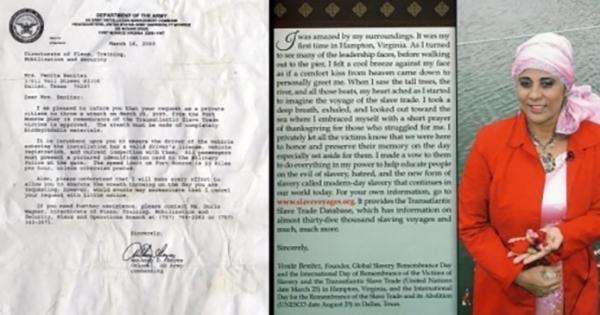
Nationwide — As the nation prepares for the dedication of the first phase of the African Landing Memorial Plaza at Fort Monroe on April 24th, in Hampton, Virginia, new attention is turning to the early, documented work of Venita Benitez, a Dallas, Texas-based remembrance advocate and the co-author of Erased on Paper whose efforts from 2008–2009 predate and align with the memorial now rising at the historic 1619 landing site.
Fort Monroe earned the name “Freedom’s Fortress” because in 1861, at the very start of the Civil War, it became the first place in the United States where enslaved people were legally protected from being returned to slavery. In 2008, Benitez launched Global Slavery Remembrance Day (GSRD) — a movement created to honor the victims of the transatlantic slave trade, reflecting on its global impact, and calling for the abolition of modern-day slavery. GSRD was conceived in the same spirit as the United Nations’ International Day of Remembrance, observed annually on March 25.
For Benitez, GSRD was never simply about dates. It was always a global call to conscience.
During this same period, she commemorated the 200-year anniversary of the 1808 Act banning the importation of enslaved Africans reception and ceremony took place on August 23, 2008, on the rooftop of the West & Associates Building. Her early work — rooted in Dallas and grounded in historical research — formed the basis of a remembrance movement that would eventually connect her to Fort Monroe.
In 2008, Benitez documented her intention to travel to Old Point Comfort, the site where the first recorded Africans arrived in 1619, to begin a formal remembrance tradition. This written documentation predates all public planning for the memorial now being built at the site.
In January 2009, while Fort Monroe was still an active U.S. Army installation, Benitez wrote directly to the base requesting permission to release a wreath in honor of the victims of slavery and the transatlantic slave trade. The Army granted her request. This letter stands as one of the earliest documented modern remembrance approvals at the site tied to the idea of a permanent memorial.
Over the years, Benitez has preserved her 2008 research, a 2009 City of Hampton mayor’s proclamation, the United States Army’s 2009 permission letter, photographs of the Remembrance in 2009, the GSRD commemoration records, 2010 Dallas Black Chamber of Commerce letter to the Honorable Mayor Molly Ward Regnald Gates – President, and a 2009 news clip that Fort Monroe staff had not seen until she presented it.
Later in 2025, she donated all materials as a gift to Fort Monroe, ensuring the full timeline of remembrance work would be preserved for future generations.
“The Tucker family maintains documented ancestral ties to Angola. Historical records show that the first Africans who arrived at Point Comfort (now Fort Monroe) in 1619 were taken from Angola. Two of those captives, Anthony and Isabella, lived in the household of Captain William Tucker, and in 1624, they had a son named William, the first recorded child of African descent born in English North America. Today, the William Tucker 1624 Society preserves this lineage, and members of the Tucker family have traveled to Angola at the invitation of the Angolan president to honor their ancestral connection. The African Landing Memorial at Fort Monroe directly acknowledges this history, depicting Anthony, Isabella, and baby William, and recognizing the deep ties between the memorial site and Angola,” says Benitez.
Her efforts have reached international audiences. Recently, descendants Anthony, Isabella, and Williams Tucker contacted Benitez to acknowledge her work and offer congratulations. “Your work is known internationally,” says Dr. Wanda Tucker.
This recognition follows a public statement released by Fort Monroe about Benitez on March 25, 2026, which brought renewed attention to her early contributions and aligned her work with African Landing and global remembrance efforts.
To learn more about Ms. Venita Benitez’s work, interested ones can explore her family story that she co-authored with her sister Carmen Benitez Deane. Their newly released book, Erased on Paper, which chronicles how their family was misclassified and erased under Virginia’s laws, is available on Amazon and Barnes & Noble
For press inquiries, contact 214-404-4433