


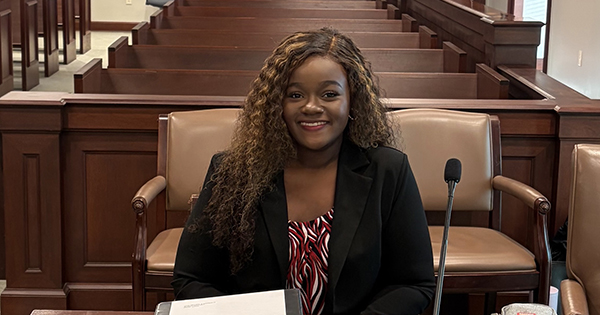
Nationwide — After a rare and potentially precedent-setting summary judgment ruling, 27-year-old Christian (Cece) Worley — a Black, second-year law student — has successfully reached a settlement in her disability discrimination lawsuit against the North Carolina Department of Public Safety (NCDPS). In her amended complaint, Worley alleged in part that NCDPS failed to accommodate her under the Americans with Disabilities Act (ADA) in May 2022 after she disclosed and requested accommodations for the symptoms of her endometriosis, a chronic and debilitating reproductive disorder affecting 1 in 10 women in the United States. At the time, Worley was employed as a Juvenile Court Counselor Trainee.
Worley filed the lawsuit without an attorney in June 2023 in the Eastern District of North Carolina after repeated denials of legal representation by various lawyers. Worley says she was told by legal professionals that the law surrounding endometriosis as an ADA disability was “too open to interpretation” and not “fully developed.” Despite this, Worley’s pro se case (Proffitt v. NCDPS, No. 5:23-cv-00306) survived summary judgment. On July 18, 2025, federal Magistrate Judge Robert T. Numbers II found sufficient evidence that a jury could conclude Worley’s request to telework on only the first day of her menstrual cycle was reasonable, and that NCDPS’ denial may have constituted unlawful discrimination. Notably, he also found that the symptoms of her endometriosis were severe enough to establish disability under the ADA. The magistrate judge’s order was later adopted in full by District Judge Terence Williams Boyle on September 30, 2025.
To the best of available case law, this is the first time in North Carolina that endometriosis has been recognized as an ADA disability, and it appears to be the first time in the nation that a plaintiff was allowed to proceed to trial on this legal theory. The case settled on December 19, 2025, and included favorable monetary terms for Worley and a commitment by NCDPS to implement enhanced, department-wide ADA training for management personnel.
According to court filings, after Worley requested to telework on the first day of her menstrual cycle in May 2022, NCDPS’ then–Chief Court Counselor for District 16 sent an internal email to his supervisor stating that he would “have to do the same for every woman” in the office. Worley further alleged that the agency’s refusal to accommodate resulted in her constructive discharge, stating that she felt she had no choice but to resign if she wanted to manage the symptoms of her condition. At the time of her accommodation request, Worley had accrued several hours of leave time, but she alleges that she was repeatedly discouraged by her supervisors from taking it
because it showed “poor work ethic.”
Worley submitted her resignation on May 12, 2022, after a meeting where her supervisors allegedly told her that there would “absolutely not” be any accommodations. In this same meeting, Worley alleged that her supervisors informed her that she would not be retained at the end of her 2-year training progression, and that if she were to mention her need for accommodations again before that time, she would be terminated immediately. Worley submitted her one week’s notice that same day, with her final working day of May 19, 2022, falling the very day before the start of her next menstrual cycle.
Court documents show that NCDPS did not dispute Worley’s diagnosis, nor any claims of satisfactory job performance. They conceded that Worley had no relevant performance issues during the time period in question. Records further reflect that Worley graduated as valedictorian of the Juvenile Justice Basic Training Program and received department-wide recognition from the Deputy Secretary of NCDPS for this achievement in July 2021.
Throughout the litigation, Worley achieved a series of notable procedural victories. In addition to her summary judgment survival, Worley defeated NCDPS’ early motion to dismiss, preserved her claims through contested discovery disputes, and conducted multiple depositions that elicited admissions from agency witnesses. Most notably, Worley successfully opposed NCDPS’ late-stage effort to compel her deposition after the close of discovery, arguing that the agency’s request was dilatory and the product of its own prolonged delay in initiating discovery. The court sided with Worley, finding that NCDPS waited nearly eight months into the discovery period to seek Worley’s deposition. This prompted the court to scrutinize the agency’s litigation tactics and ultimately deny NCDPS’s request to extend the discovery period solely to depose Worley.
Worley’s case is a rare example of a pro se plaintiff prevailing through legal merit and civil procedure acumen, as less than 3% of cases filed without legal representation make it past summary judgment. Worley hopes her case sparks broader conversations about access to justice, especially for impoverished and vulnerable communities who are often barred from asserting their rights, whether due to lack of legal knowledge, discouragement, or widespread disinterest from the legal community.
The case gained significant traction online after Worley’s story was shared on social media platforms and featured on WRAL, North Carolina’s leading news outlet. Worley says the public response has been overwhelming. Hundreds of women have reached out to share similar stories; many also report termination or threats of termination after disclosing menstrual or reproductive health conditions. A Change.org petition citing Worley’s case and demanding an investigation from federal agencies has already garnered nearly 4,000 signatures. Moreover, disability rights advocates are now citing her case as a growing precedent in ADA issues involving endometriosis and reproductive health within the workplace.
“Refusing to back down in the face of injustice is what turns a single person’s win into systemic change,” said Worley. “This case was never merely about me. It is about every woman whose pain has been dismissed, whose livelihoods have been threatened for having gendered disabilities beyond their control, and who are told that their chronic pain is something that they must silently endure.”
This legal breakthrough signals a growing reckoning in workplaces across America, particularly for Black women, who face compounding discrimination based on race, gender, and disability. Black women are significantly less likely than White women to receive a diagnosis of endometriosis, even though the condition affects people across all racial groups. In multiple large studies and systematic reviews, Black women were found to be roughly half as likely to be diagnosed with endometriosis compared with their White counterparts, and they often endure longer delays in care, dismissals of pain, and unequal treatment before receiving a diagnosis.
Advocates say it is long past time for employers, courts, and policymakers to acknowledge the real-world impact of endometriosis and other invisible disabilities. With Worley’s case, that reckoning has begun.
Worley is currently pursuing her J.D. at Georgetown University Law Center as an NAACP Legal Defense Fund Marshall-Motley Scholar who has committed to serving as a civil rights attorney after law school to advance racial justice in the South.
This lawsuit and all related legal filings were undertaken entirely in Worley’s personal capacity prior to law school and do not reflect the positions of Georgetown University Law Center or the NAACP Legal Defense Fund’s Marshall-Motley Scholars Program.
For interviews, speaking requests, or to access case documents, please contact cwmedia11@outlook.com