


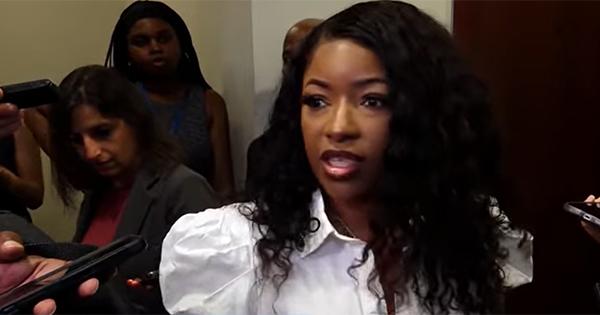
Nationwide — Jasmine Crockett, a 44-year-old civil rights attorney and rising Democratic star from Texas, is weighing a defining choice that could shift the political landscape for African Americans and for Democrats nationwide. Born in the South and known nationally for her fiery exchanges with Republicans, she now holds two cashier’s checks—one to seek reelection to the U.S. House, and another to launch a U.S. Senate bid. Her decision is due Monday, just minutes before the filing deadline, and she has already invited hundreds to an announcement event without revealing which direction she will take. To Crockett, the dilemma is a privilege: the kind of crossroads few Black women in Texas politics have ever reached.
According to CNN, in the days leading up to her decision, Crockett has been on the phone nonstop, speaking with supporters, allies, and potential rivals, many of whom walked away convinced she is leaning toward the Senate race. She has even floated the idea of reshuffling the Democratic field—suggesting Colin Allred pursue the governor’s office and encouraging Rep. Joaquin Castro to consider a statewide run of his own. Crockett has also leaned on early polling that shows her competitive, though some Democrats note the surveys rely on small sample sizes. She has coordinated privately with Rep. Marc Veasey about the timing of filings if she vacates her House seat.
Crockett has also reached out to Stacey Abrams to discuss what it might take to expand turnout in a state Democrats have long dreamed of flipping. Her appeal is undeniable: she has become one of the most viral Democrats in America, a Black woman unafraid to publicly confront Donald Trump or trade shots with conservative firebrands like Marjorie Taylor Greene. That bold persona has energized young voters, disillusioned Democrats, and especially Black and Latino communities. But her critics warn that the same firepower could also ignite Republican turnout—especially in a state where Democrats have not won statewide since 1994.
Republicans, meanwhile, are consumed with their own internal battles. With Sen. John Cornyn facing challengers like Ken Paxton and Wesley Hunt, the GOP primary is shaping up to be bruising and expensive, likely dragging into a runoff. If Paxton emerges as the nominee, Democrats would face a candidate weighed down by years of scandals, legal threats, and impeachment drama. Some in the party see this as the rare opening they have waited decades for. Yet others worry that a Crockett candidacy, with her past verbal misfires—including remarks about Gov. Greg Abbott’s disability—could overshadow Republican vulnerabilities and put down-ballot Democrats at risk.
Crockett rejects the notion that she is rushing into anything. In an extended interview, she emphasized that she has studied her polling, weighed the opposition research, and understands both her strengths and her liabilities. She argues that her national profile, fundraising ability, and connection to Democratic voters make her uniquely capable of driving turnout in communities often overlooked. She acknowledges that Texas is enormous, expensive, and politically complicated—but insists that boldness, not caution, is what the moment requires. For her, the question is whether she can start from a viable position in a race where every move will be scrutinized.
As she heads into Monday’s deadline, Crockett is balancing ambition with risk. She knows that winning statewide in Texas would require near-perfect execution and a united Democratic front—something the party has struggled to assemble. She also knows that if she leaves the House to chase the Senate and loses, her voice could be absent during a potential second Trump presidency. But the barrage of criticism she has received from both the left and the right has only strengthened her resolve. As she put it, “I eat attacks for breakfast.” Now the state waits to see whether that fighting spirit will remain in her district—or be unleashed on a Senate race that could redefine Texas politics.